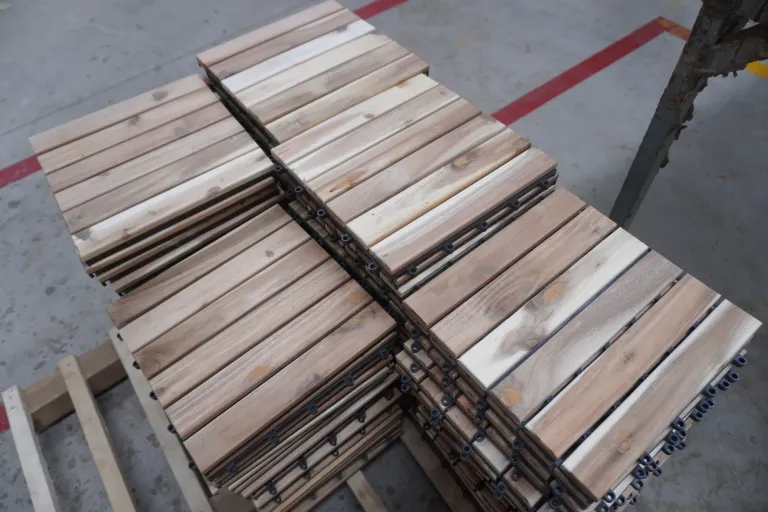

Acacia vs composite deck tiles is the first material choice in any deck-tile range. Both types click together on an interlocking base and lay on any firm, level surface, but they look, age and feel different, and that changes who buys them and what they ask for afterwards. This guide compares acacia deck tiles (hardwood slats on a plastic base) with composite deck tiles (slats made from a wood-plastic composite, often called WPC) so importers and retail buyers can decide which one, or which mix, belongs in their range.
Acacia vs composite deck tiles at a glance
| What you compare | Acacia deck tiles | Composite deck tiles |
|---|---|---|
| Look | Natural grain and colour variation: no two tiles are identical | Uniform colour and a repeated grain pattern, tile after tile |
| Upkeep | Optional outdoor oil to keep the colour; without it the wood weathers to a silver-grey | No oiling; clean with soap and water |
| Ageing outdoors | Wood moves with humidity and changes colour with sun and rain | Usually steadier in size; colour can still fade in strong sun, depending on the product |
| Heat in direct sun | Warm; light colours stay cooler than dark ones | Also warm; many users report dark composites feel hotter, so test samples in real sun |
| Weight | Lighter slats | Composite slats are usually denser, so cartons are often heavier |
| Repairs | Lift and replace a single tile | Lift and replace a single tile |
| Material story | Renewable plantation wood; FSC certified supply is possible | Often wood fibre plus plastic, sometimes recycled; check the claim and the end-of-life options |
| Typical buyer | Wants a real-wood look and feel and accepts some care | Wants low upkeep and a consistent colour |
The table shows tendencies, not rules: composite formulations and wood quality both vary widely between factories, so always compare samples, not descriptions.
Where acacia deck tiles win
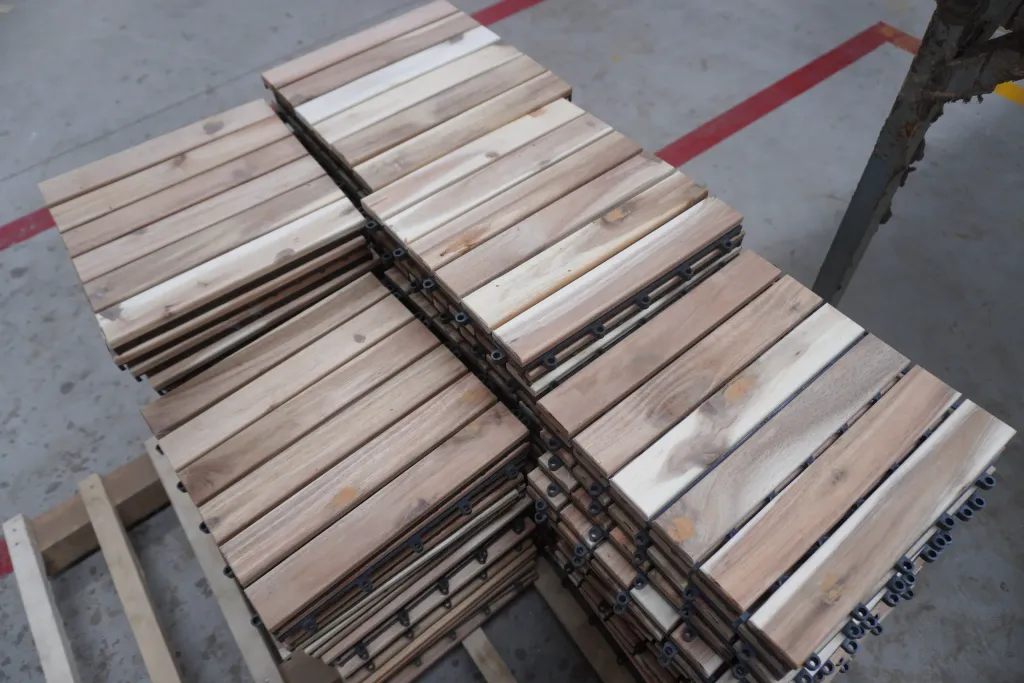
- Real wood appearance. Customers who want a warm, natural deck accept variation as part of the charm, and it photographs well on packaging and in stores.
- Easy to cut and fit. A fine-toothed saw trims edge tiles cleanly, as described in our installation guide.
- Lighter cartons. Lower weight per tile helps handling for customers and freight weight per container.
- A clear sustainability story. Plantation acacia from managed supply, with FSC® certification available, answers the question many retail and hospitality buyers now ask first.
Where composite deck tiles win
- Low upkeep. No oiling and no staining. Customers who never want to maintain a deck will prefer it.
- Consistent colour. A uniform colour makes shelf and online displays predictable and reduces complaints about variation.
- Stable size. Composite slats usually move less with humidity than solid wood.
Composite is not maintenance-free in every respect: surfaces can stain or grow mildew in damp, shaded places, and some products fade. Ask for the maker’s weathering data, not only the brochure.
What this means for a retail range
Many retailers carry both materials at different price points and use the wood tile to anchor the natural-look shelf. Whichever you choose, three decisions protect your margin after the sale.
- Set expectations on the carton. For wood, say that grain and colour vary and that the tile weathers outdoors unless oiled. For composite, say what cleaning is needed.
- Put the installation steps in the box. Tiles that are laid correctly on a firm, level surface cause fewer returns.
- Choose one interlocking system per range. Tiles from different makers rarely click together, so a mixed floor only works within one system.
If you are also choosing between slat counts, our 6-slat vs 12-slat guide explains how the two patterns read on a finished floor.
Questions to ask any deck tile supplier before you order
- What is the exact material of the slats and of the base, and how thick are they?
- Which colours are standard, and how much do they vary from batch to batch?
- What finish is on the tile, and is an outdoor oil supplied or recommended?
- For wood: what moisture content is the wood dried to? (See moisture content for export.)
- Can you test a sample outdoors for a season, in sun and in rain, before you commit?
- How are the tiles packed, how many to a carton and how many cartons to a container?
- Which certificates and documents come with the shipment?
- What are the minimum order quantity and the lead time? We confirm both with every quotation.
Our acacia deck tiles
THH Furniture makes acacia deck tiles in 6-slat and 12-slat designs, 300 x 300 mm and 24 mm thick, on an interlocking plastic base, and can ship up to 30 containers of decking tiles per month. See the decking tiles range, the 6-slat tile and the 12-slat tile. Our OEM/ODM service covers dimensions, finish, colour, hardware, packaging and private label. FSC® 100% is available on request (Chain of Custody certificate SA-COC-016121, licence FSC-C226314); when you order FSC, the claim is stated on the invoice and shipping documents. To talk about your range, request a quote.
Frequently asked questions
Are composite deck tiles better than wood deck tiles?
Neither is better in every case. Composite suits buyers who want low upkeep and a uniform colour; acacia suits buyers who want a real-wood look and accept some care. Many retailers stock both.
Do acacia deck tiles need oiling?
Oiling is optional. An outdoor oil keeps the original colour longer; without it, the wood weathers to a silver-grey, which some customers like.
Are composite deck tiles hot in summer?
All deck surfaces warm up in direct sun, and dark colours warm up more than light ones. Many users report that composite feels hotter than wood, so test samples in real sun before you choose.
Which lasts longer outdoors, acacia or composite?
Lifespan depends on the quality of the product, the climate and how the tiles are laid and cared for. Ask each supplier for weathering test data or a long sample trial instead of relying on a number of years.
Can I mix wood and composite tiles on one deck?
Only if they use the same interlocking system and thickness. Tiles from different makers often do not connect, so check the base and the connectors on samples first.