FSC 100% vs FSC Mix vs FSC Recycled is the first question most importers ask when a supplier says its wood is “FSC certified”. The three names are the main FSC claims for wood products and they do not mean the same thing. This guide explains each claim, how Chain of Custody certification connects the forest to your product, how to check a supplier’s certificate yourself and how the claim should appear on your paperwork.
What FSC is
The Forest Stewardship Council (FSC) runs an international, voluntary certification system for forests and for the companies that process and trade forest products. Forest management certification applies to the forest itself. Chain of Custody (CoC) certification applies to each company that handles the material after the forest: the sawmill, the factory, the trader. A company needs its own CoC certificate to make FSC claims about the products it sells.
FSC 100%, FSC Mix and FSC Recycled
| Claim | What it means | Example |
|---|---|---|
| FSC 100% | All the wood in the product comes from FSC-certified forests | A board made only from wood grown in an FSC-certified plantation |
| FSC Mix | The material is a mix of FSC-certified wood, recycled material and/or FSC Controlled Wood | A panel made from a blend of certified and controlled material |
| FSC Recycled | All the material is recycled (reclaimed) wood or fibre | A product made only from reclaimed wood |
FSC Controlled Wood is material checked for the risk of coming from unacceptable sources. It can be blended with certified material in FSC Mix products, but a product made only of controlled wood does not carry an FSC label. FSC Mix also comes as a percentage claim (for example, FSC Mix 70%) or a credit claim, so ask which one applies and what share of the product is certified.
How Chain of Custody works
Each company in the chain keeps records that follow certified material from the forest to the finished product: what came in, what was made and what was sold with which claim. An independent certification body audits those records regularly. When a product leaves a certified company with an FSC claim, the claim is written on the invoice and on the delivery or shipping documents, together with the company’s certificate code.
Using the FSC logo or label on a product, a carton or marketing material is a separate step that needs a trademark licence and approved artwork. A claim in words on your documents does not replace that approval.
How to verify a supplier’s FSC claim
- Ask for the certificate code and the licence code, for example a code that starts with the certification body’s letters and ends in a number.
- Search the code in the public certificate database at info.fsc.org.
- Check the status and dates: the certificate must be valid on the day of shipment.
- Check the scope: which products, species and sites the certificate covers.
- Match your order to the scope: a product outside the scope cannot carry the claim, even if the supplier holds a certificate.
- Check your documents: the invoice and shipping documents should show the exact claim (for example FSC 100%) and the certificate code.
Our guide what FSC 100% Chain of Custody means for importers goes through the same checks in more detail.
What an FSC claim does not cover
- Anything outside the scope. A certificate covers named products, species and sites. Our own certificate covers plantation Acacia mangium and hybrid; pallets and plywood are outside its scope, so we never pair FSC wording with them.
- Your own country’s import rules. FSC is a voluntary standard. It does not replace the import documents and checks that apply in your country, so confirm those separately.
- The logo. Whether a supplier may place the FSC logo on a product depends on approved artwork under its trademark licence. We do not place the logo until our certification body has approved the artwork.
FSC at THH Furniture
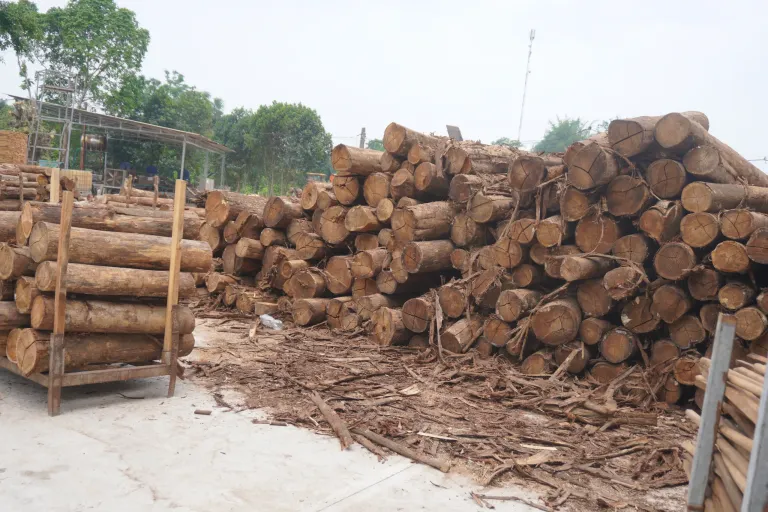
THH Furniture Vietnam JSC holds FSC® Chain of Custody certificate SA-COC-016121 (licence FSC-C226314), covering FSC 100% Acacia mangium and hybrid, valid from 09 March 2026 to 08 March 2031. Our acacia comes from our own plantations, with no natural forest harvesting. FSC® 100% is available on request for our outdoor furniture, boards and panels and deck tiles; when you order FSC, the claim is stated on the invoice and shipping documents. The certificate details are on the FSC certificate page and the sustainability page, and you can request a quote with FSC 100% as a requirement.
Frequently asked questions
What does FSC 100% mean?
It means that all the wood in the product comes from FSC-certified forests. The supplier must hold a valid Chain of Custody certificate that covers the product.
What is the difference between FSC 100% and FSC Mix?
FSC 100% products contain only wood from FSC-certified forests. FSC Mix products combine certified wood with recycled material and/or FSC Controlled Wood, and the share of certified material can vary.
Is FSC Recycled the same as recycled wood?
FSC Recycled means that all of the material is recycled or reclaimed and that the supplier’s certificate covers it. Wood described as recycled without a certificate cannot carry the FSC claim.
How do I check that a supplier is really FSC certified?
Ask for the certificate code, search it in the FSC public certificate database, and check the status, the validity dates and whether the scope covers the products and species you are buying.
Can I use the FSC logo on my packaging?
Only with the right trademark licence and approved artwork. A claim written on the invoice does not give you the right to print the logo, so ask your certification body or FSC before you design the packaging.