Solid acacia panels come in four main constructions, and choosing the wrong one is a common reason for disappointing samples or avoidable cost. This guide compares finger-jointed boards, full-length edge-glued panels, live-edge boards and herringbone panels: how each is made, how it looks, where it is typically used and what to write in your spec sheet before you request a quotation from THH Furniture Vietnam.
All four are made from acacia, kiln-dried to your market target and sanded before they leave the factory. The differences lie in how the wood is assembled, and that decides look, yield and price.
Solid acacia panels at a glance
| Type | How it is made | Look | Typical uses |
|---|---|---|---|
| Finger-jointed board | Short lamellas finger-jointed and edge-glued | Even, with visible joints | Shelves, worktops, stair treads, furniture components |
| Full-length edge-glued panel | Full-length staves glued edge to edge | Continuous grain | Dining tables, butcher blocks, stair treads |
| Live-edge board | Solid board with natural edge kept | Unique, organic | Statement tables, shelves, counters |
| Herringbone panel | Cut lamellas laid in a herringbone pattern | Decorative pattern | Table tops, feature furniture |
You can browse the full range under boards and panels.
Finger-jointed and full-length edge-glued solid acacia panels
Finger-jointed boards
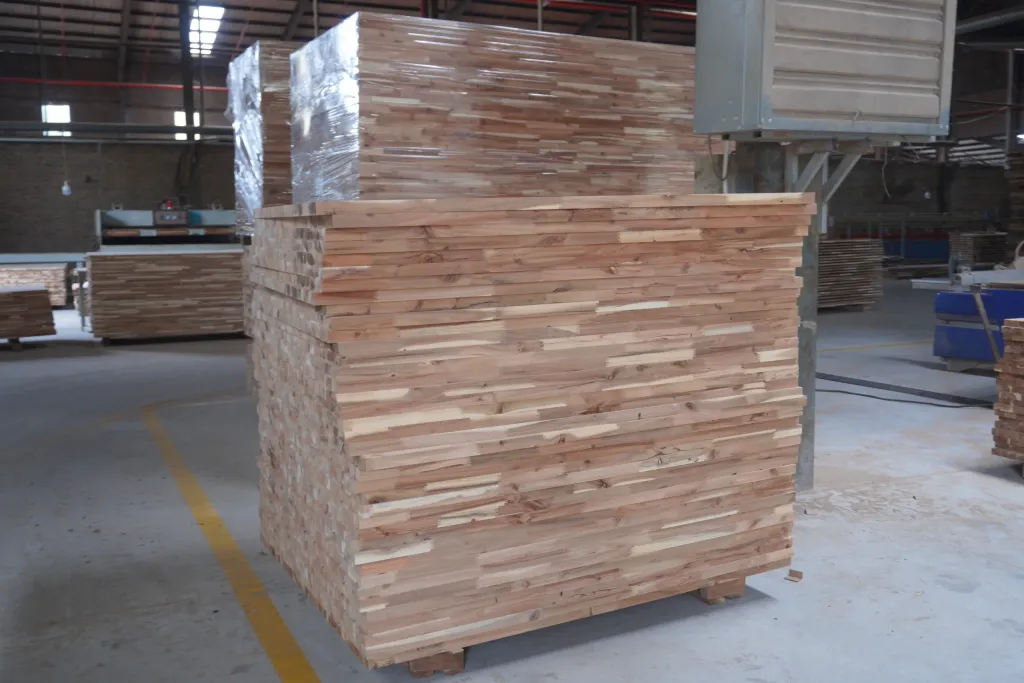
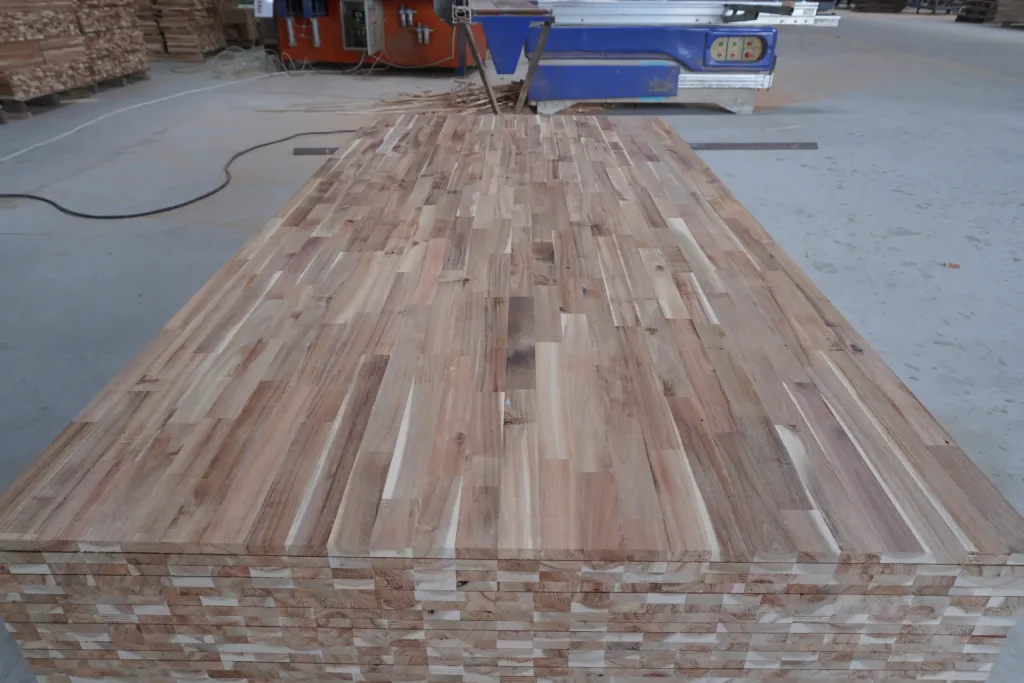
Short acacia lamellas are graded, finger-jointed and edge-glued with a D4 water-resistant adhesive into a stable panel. Lamella width runs 35-85 mm and length 120-850 mm. Both top-finger (horizontal) and side-finger (vertical) joints are available, and the look changes with the choice.
Because short pieces can be used, this is typically the most efficient way to turn timber into a large panel, and yield is generally better than with full-length staves. Standard formats include 2,440 x 1,220 mm and the EU and US sizes listed on the product page, with custom sizes on request. Thicknesses range from 12 to 32 mm.
Full-length edge-glued panels
Here the staves run end to end with no finger joints, giving the uninterrupted grain buyers expect on premium tops. Staves are colour-matched, edge-glued with D4 adhesive, calibrated to thickness and sanded on both faces.
The trade-off is material: long, clean staves are harder to select, so these panels usually cost more than finger-jointed boards. They suit dining tables, butcher-block worktops and stair treads, where a continuous look is part of the value.
Live-edge boards and herringbone panels
Live-edge boards
Each board keeps the natural edge of the tree, so no two pieces are the same. Boards are kiln-dried, flattened and sanded, ready for finishing, and supplied in widths and lengths to order with grading agreed per project. Wide single boards typically move more with humidity changes than glued-up panels, so agree the moisture target and the end use early.
Herringbone panels
Precision-cut lamellas are assembled in a herringbone layout and glued into a stable panel, giving designers a ready-made decorative surface. Panel size, lamella size and finish can be specified per project. Typical uses are dining table and office table tops.
Moisture, tolerance and stability
The stability of solid acacia panels starts in the kiln. Boards are dried to the moisture target of your market: 8-12% for EU and US, 10-14% for Japan. Wood delivered far drier or wetter than the destination climate tends to cup, shrink or open at the joints, which is why the target belongs in the spec.
Boards and panels are machined to tight dimensional tolerances of ±2 mm in length and width and ±0.2 mm in thickness, as listed for the finger-jointed, full-length and herringbone products. For live-edge boards, the edge follows the tree, so dimensions are agreed per order.
Finishes, grades and packing
Standard surface is sanded P180-240 on both faces, with further finishing to order. Natural, oil, stain and custom colour finishes are matched to your approved sample; see materials and finishes for grading and finishing detail. Panels are graded from AA to CC, so you can match visible faces to visible applications and use lower grades for hidden components.
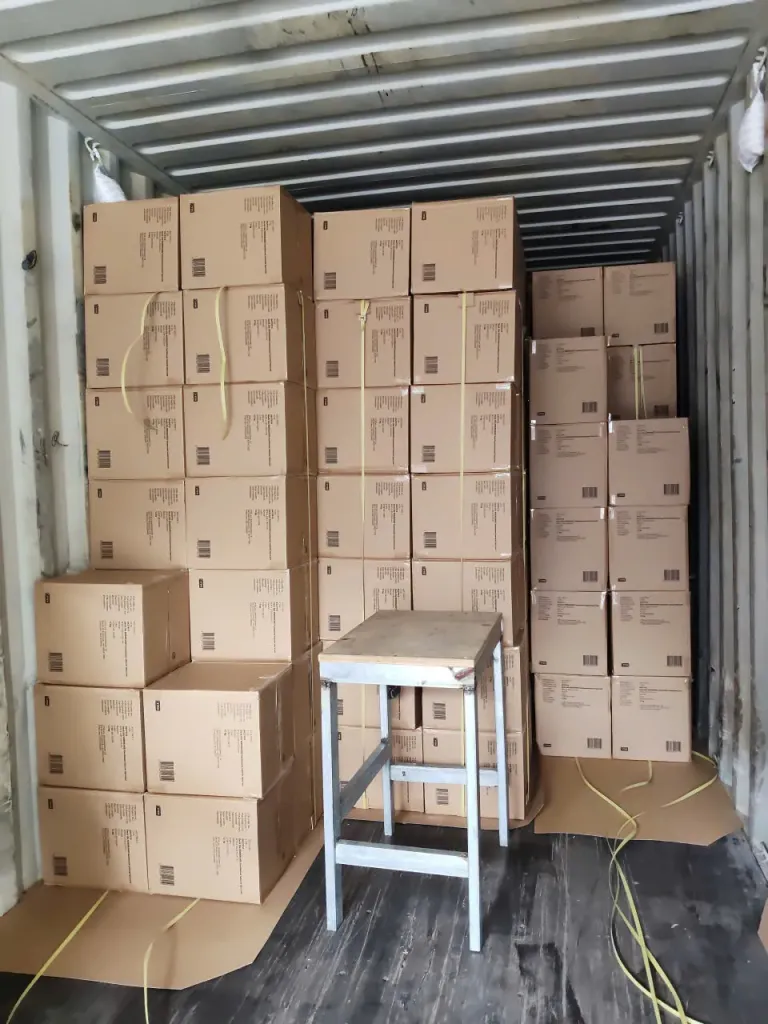
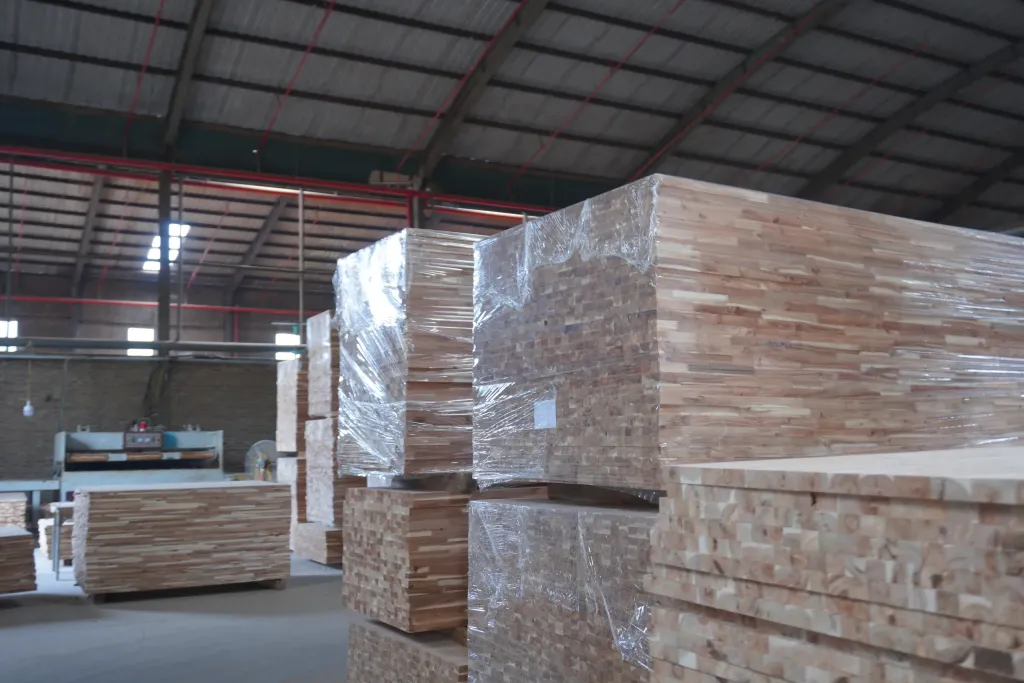
Solid acacia panels ship palletised with PE/POF shrink wrap, and finger-jointed and full-length panels also use slip sheets. FSC 100% acacia is available on request, with the claim on the invoice when the order is placed as FSC.
What to put in your spec sheet
A complete spec sheet prevents most sample rounds. Include:
- Construction type: finger-jointed (top or side finger), full-length, live-edge or herringbone
- Species (acacia) and whether FSC 100% is required
- Length, width and thickness, plus tolerance
- Grade (AA to CC) and which face is visible
- Destination market, so the moisture target can be set
- Surface and finish: sanded only, oiled, stained or custom colour
- Glue class (D4) and end use, such as butcher block or stair tread
- Packing, labelling and quantity per shipment
Minimum order quantities and lead times are confirmed with your quotation.
Frequently asked questions
Which panel suits a butcher block?
Finger-jointed, full-length and live-edge acacia are all listed for butcher-block use. Full-length staves give a continuous grain, while finger-jointed boards suit larger formats. If the surface will contact food, tell us your finish requirements at RFQ stage.
Are finger joints a weak point?
A finger joint is a glued joint designed for load, bonded with D4 adhesive. Joint strength is checked on the line as part of in-process quality control. Choose full-length panels when you want the look of unbroken grain, not because the joint is a defect.
Can I order custom sizes?
Yes. Custom sizes are available on request for finger-jointed and full-length panels, and live-edge boards are supplied to order. Send your dimensions and thickness with the RFQ.
Is FSC available for acacia panels?
FSC 100% is available on request for acacia panels, with the claim on the invoice when ordered. Pine, ash and birch are also offered on the finger-jointed range, but FSC 100% on our product schedule covers plantation Acacia mangium and hybrid.
Ready to compare solid acacia panels? Send your spec sheet and target market and we will reply within 24 hours, Monday to Friday (GMT+7).